What does an S-STEM project look like once the new award announcement is over and the work begins? In practice, the answer is more consistent and perhaps less unique or innovative than many people expect. S-STEM projects do not simply distribute scholarships; they build ecosystems of support that help academically talented, low-income students persist, succeed, and move through STEM pathways with greater confidence and fewer barriers.
That broader work does not happen in isolation. The S-STEM Research Hubs examine the conditions, structures, and interventions that shape student success across different contexts. The ROPES Hub brings together a collaborative team from Virginia Tech, Weber State University, the University of Cincinnati, and the University of Oklahoma to study and strengthen the partnerships that support low-income students in engineering, computer science, and computing. Through accelerator grants, mentorship, and a growing community of practice, the Hub supports S-STEM teams that are developing, maintaining, or sustaining intra- and inter-institutional partnerships. At the same time, the ROPES team conducts cross-cutting research to identify the organizational conditions and partnership practices that can extend support beyond individual scholars to departments, institutions, and STEM pathways.
Two Studies That Illuminate S-STEM Practice
This post draws from two complementary studies of ROPES Hub research focused on S-STEM programs including engineering and computer science. The first was a systematic literature review (SLR) of 288 S-STEM publications focusing on engineering and computer science, which allowed us to examine the activities and partnerships highlighted in the published literature. The second was an analysis based on 37 interviews across 19 funded S-STEM projects that compared actual program design choices with the required and encouraged elements in NSF’s solicitation. Together, these studies help reveal not only what S-STEM projects are doing, but also how those choices are shaped by context, partnerships, and the program’s broader expectations for student success.
Activities
Across both studies, several activities appeared repeatedly, including scholar recruitment, course-based supports, and mentoring provided by faculty, peers, and alumni. These patterns align with the broader set of evidence-based curricular and co-curricular supports commonly used across S-STEM projects, including cohort formation, mentoring, academic support, and professional development. Figure projects. Figure 1 presents the full range of activities identified across the 288 S-STEM publications included in the SLR. Collectively, the publications described 19 activity types, with an average of 6.8 distinct activities per publication.
Our interviews with PIs showed that activity design is not static. Many described revising their original plans in response to scholars’ needs, interests, and changing circumstances—programs often reduced the number of activities in favor of a smaller set of more meaningful, well-supported activities.
How I approach the program resources has slightly changed. I look at what’s really absolutely necessary for them first now compared to everything that should be included. And then adjust to yearly activities for them that would be meaningful. – Interviewed S-STEM PI
The emphasis on responsiveness suggests that strong S-STEM program design is not defined by the number of activities offered but by the intentionality with which teams tailor supports to the scholars and institutional context they serve.
Although projects described a wide range of possible activities, many were built around a similar core of supports. A smaller group of projects stood apart by combining activities in less typical ways or incorporating relatively uncommon elements, such as service-learning or study abroad. These activity outliers offer an opportunity to consider how S-STEM teams may innovate activities that respond to their specific scholars’ interests, needs, and institutional contexts.
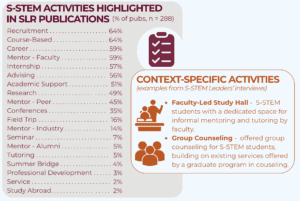
Figure 1. Information about S-STEM activities offered by programs included in the SLR and S-STEM leadership interviews.
Partnerships
Partnerships were another defining feature of S-STEM practice. Nearly every engineering and computer science S-STEM program described at least one internal or external partnership. On average, publications reported 3.2 internal partnerships and 1.2 external partnerships, including community colleges, other universities, employers, and other organizations. Internal partners may include faculty, advisors, tutoring or learning-support staff, student affairs personnel, financial aid offices, etc. Internal and external connections help projects link scholars to the academic, financial, professional, and social supports that often sit beyond any one department or program.
Just as important were partnerships that are easy to overlook. Staff who manage scheduling, communication, and data often keep projects running in ways that are invisible in a proposal narrative. Alumni, employers, family members, and informal campus connectors can also shape whether students access opportunities and stay engaged. In many projects, the quality of the relationship between institutions or offices mattered as much as the formal partnership structure itself. That is especially true in projects that serve transfer students, where coordination across settings can either smooth the pathway or create new friction.
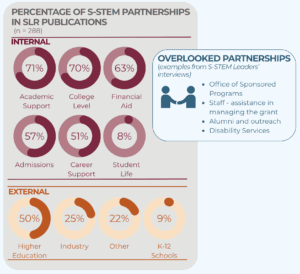
Figure 2. Information about S-STEM partnerships included in the SLR and S-STEM leadership interviews.
Identifying Activities & Partnerships to Best Support Your Scholars
The set of activities and partners identified in these studies are not a prescription for building a “complete” S-STEM program. Instead, they offer a starting point for purposeful reflection: What supports do your scholars need now, and which activities are most likely to address those needs in your institutional context? Evidence-based activities should be adapted to the realities, strengths, and resources of a particular campus and its scholars—not added simply because they appear in another project or proposal.
Offering more activities does not necessarily mean better support. A smaller, intentionally designed set of activities, delivered consistently and adjusted in response to scholar feedback, may be more meaningful than a long menu of offerings. Focusing on a smaller set of activities will also be more manageable for your leadership team. Teams can begin by identifying which supports already exist on campus. Rather than recreating those services within the project, consider how S-STEM can create clear, supported connections between scholars and the people who provide them.
Treat partnerships as more than a list of collaborators. Strong partnerships require shared goals, clear roles, reliable communication, and an understanding of how each partner contributes to scholar success. Intentional partnerships can help teams reduce duplication, strengthen pathways across offices and institutions, and ensure that support remains responsive as scholars’ needs evolve. A practical first step is to meet with partners to identify a shared student-success goal, clarify what each person or office will contribute, and agree on how and when the group will communicate. Revisit and nurture these partnerships regularly, using scholar feedback and shared data to identify gaps and adjust supports as students’ needs evolve. Rather than thinking about your team’s relationships with offices on campus as a set of transactional activities (e.g., “financial aid, please administer a scholarship”), try reframing your mindset to work collaboratively in a partnership (e.g., “financial aid, let’s work together to support this student”).
References
Knight, D., Watford, B., Lee, W., Grohs, J., Reed, T., Imbrie, P. K., Grote, D., Richardson, A., Klopfer, M., Johnson Austin, S., & Berhane, B. (2023). Board 354: Organizational Partnerships S-STEM Research Hub. 2023 ASEE Annual Conference & Exposition Proceedings, 42992. https://doi.org/10.18260/1-2–42992
Richardson, A. J., Knight, D. B., & Lee, W. C. (2026). How Organizational Partnerships Spark Information Sharing in a Quest for Sustainable, Institutional Change. Community College Journal of Research and Practice, 1–18. https://doi.org/10.1080/10668926.2026.2630345
Rodriguez, S., Work, A., Richardson, A. J., Knight, D. B., & Lee, W. C. (2024). Leading S-STEM Programs Within Higher Education Contexts: How Leaders Create Change for Academically Talented STEM Students with Financial Need. Association for the Study of Higher Education Conference.
Rodriguez, S. L., Chaback, B., Work, A., Richardson, A. J., Reeping, D., & Knight, D. B. (2025, November). WIP: What Does Mutuality Look Like? Comparing How MSIs and Non-MSIs Engage in S-STEM Partnerships to Serve Low-Income Engineering and Computing College Students. In 2025 IEEE Frontiers in Education Conference (FIE) (pp. 1-4). IEEE.
Additional Resources
Explore additional resources and practices briefs on the ROPES Hub website.